Student Digital Champions
I recently embarked on a new challenge at the University of Plymouth, supporting the institution with the rollout of a new digital examination platform. This means that after five years, I’ve concluded helping to build the Student Digital Champions at the institution, which is now part of a new learning support team.

I originally joined the Digital Champion scheme during its original pilot run, under the COVID-19 lockdown restrictions in the UK at the time. At its outset, the scheme fed the student voice into decision making processes about the usage and provision of digital tools and technologies within the institution.
From humble beginnings, the peer-support scheme grew to include the design and provision of bespoke digital skills seminars and operated a digital literacy drop-in service. Growing from a team of three student partners to a team of fourteen, the Digital Champions experienced an approximate 850% service usage growth between the academic years in 2022 and 2025.
Our publication in the Journal of Educational Innovation, Partnership and Change charts the evolution of the scheme between 2021-2023.
Over the years, we had a number opportunities to share what we were building with other higher education institutions in the UK. As part of a wider student panel exploring digital advocacy, we shared our experiences of online learning during the COVID restrictions at JISC Digifest, JISC Connect More and JISC Change Agents Network in 2022. We returned to JISC Change Agents in May 2023 and spoke about empowering student partners as co-creators at the Advance HE: Students as co-creators symposium in January 2024.

The rise of AI in Education
With the higher education sector increasingly relying upon digital technologies to provide learning experiences, it’s important that we recognize the value of empowering students to become digital advocates through peer-support in the environments that we are creating. Within the UK HE context, we’ve entered a new era of learning experiences where University entrants have been using Large Language Models (AI) since secondary school.
If we reflect upon massive technological impacts in education, we could perhaps view the 2000s as the era where “Google” became synonymous with using an internet search engine to answer a question. Students were turning to Google to find an answer from the growing library of information on the world wide web rather than trekking over to the physical library and asking for help.
We might later reflect upon the 2020s as the era in which the practicalities of seeking knowledge have changed once again, where “ChatGPT” replaces “Google” as the synonym for technological extensions of the human mind engaging in information retrieval. The place of AI in Education is therefore an important conversation that is happening at Universities around the world already.
Whilst the government in the UK has started to form policy on the issue: I’m wondering however, what extent is the sector taking advantage of the student voice and their student communities to understand how new University entrants and young people are integrating AI into their day-to-day learning experiences? Is the sector, are we listening enough?
Learning from the student voice
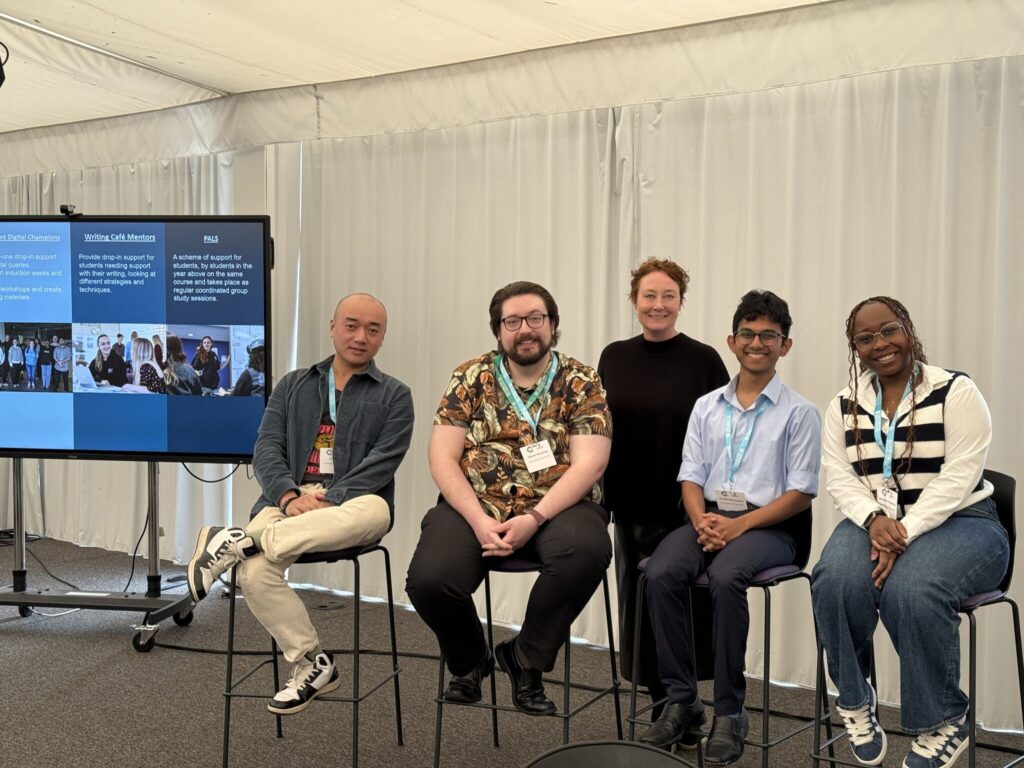
Last year, I was invited to speak to the British Association of Lecturers in English for Academic Purposes for (BALEAP 2025) about how our Digital Champions supported international students. Picking up sticks and moving to a new country is daunting, but this can be even more so challenging for international students entering the UK education system for the first time.
Not only do they have to learn new cultural and social norms, but they also must learn new digital ecosystems. To those of us that these systems are native for, our experience with them makes it easy to forget what learning to use them felt like. This means that there are gaps in our how we provision teaching and learning where knowledge of these systems is taken for granted. We assume that all of our students are on an equal footing in our digital ecosystems. That’s where peer-support schemes like the Digital Champions act as an invisible safety net. The experiences and voices of the student partners, positioned as experts through experience, enables those students to whom these systems are unfamiliar to gain insight that isn’t currently provisioned through formal timetabling.
So, what if we reverse the roles when we approach the conversation about AI in Education. Colleagues that experienced the rise of search engines replacing reference textbooks and the transition to digital assessment submissions – now resistant to the innovation of AI in Education – should perhaps be viewing new University entrants as the experts in AI.
If we’re not open to learning from them what role AI is playing in their lives, we risk being left behind whilst we’re standing at the front of the classroom.