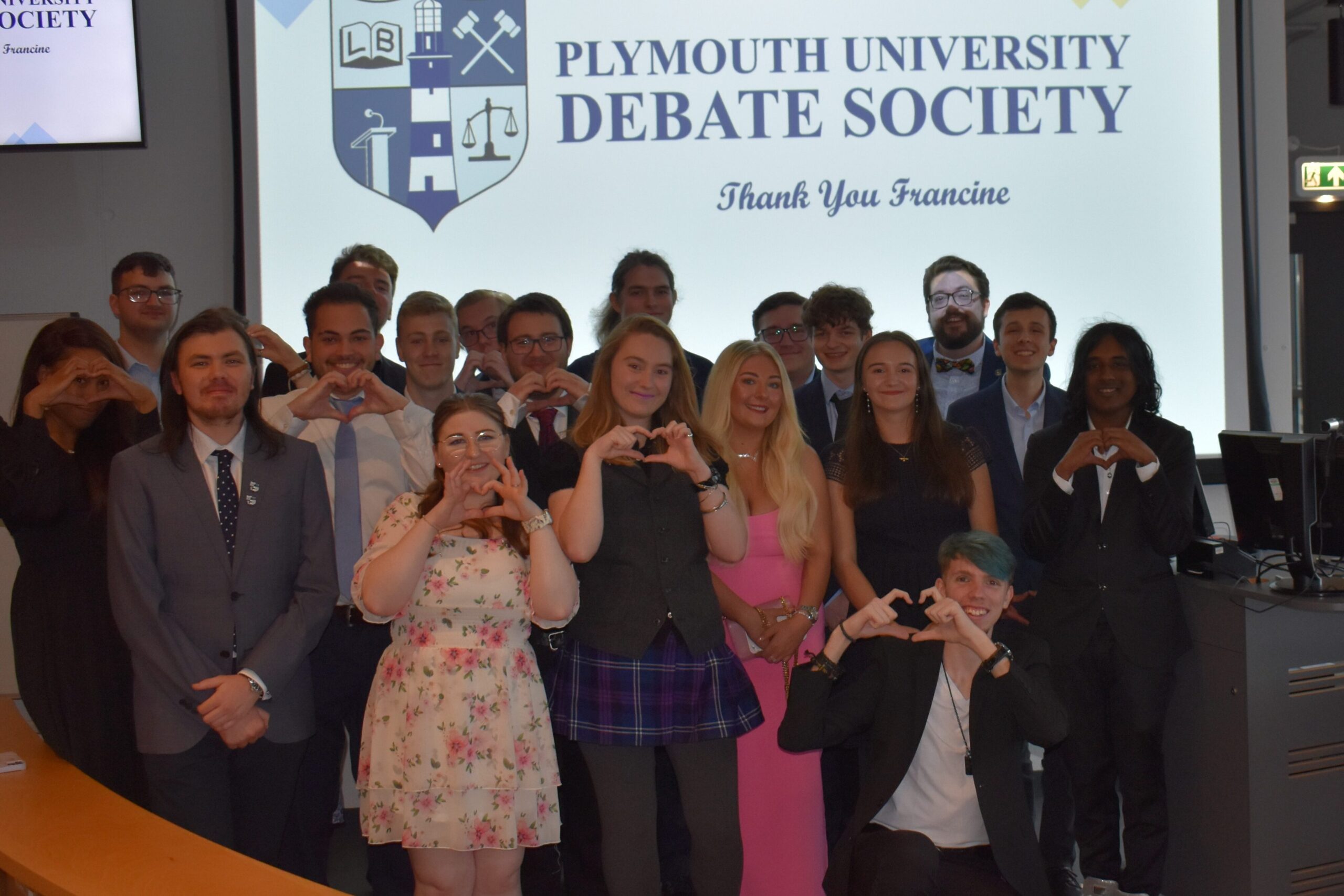
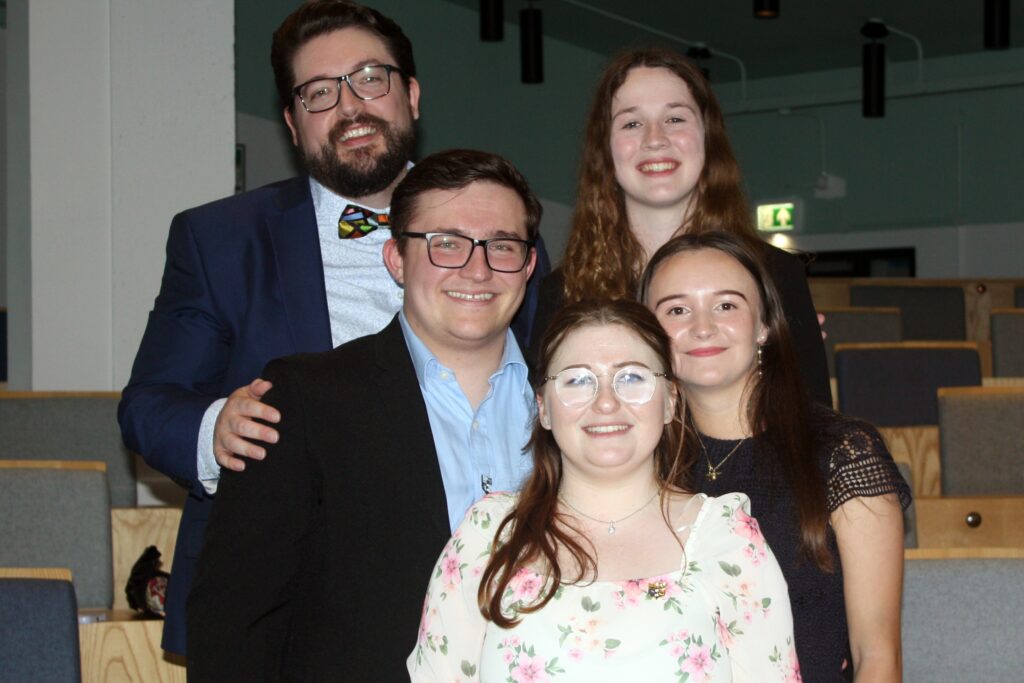
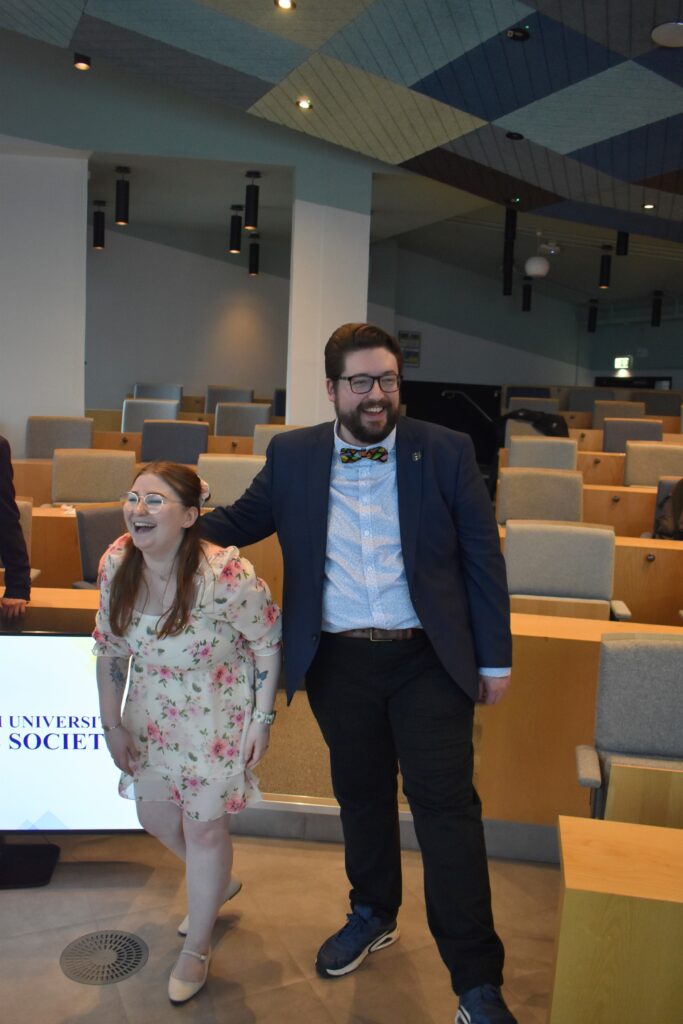
One of my favourite events after the Easter spring break at the University of Plymouth is the annual Debate Society awards ceremony. We began this tradition almost five years ago and it continues to be an enjoyable occasion that highlights the achievements of society members across a given academic year.
Public speaking and being able to shoot from the hip are invaluable skills approaching the graduate job market. Reflecting back to our keynote at Ahead at Bett a couple of years ago, we explored the conversation on how workplaces need to adapt welcoming Gen Z into the workforce for the first time. It is worth recognizing the tremendous pressure that Gen Z are under to stand out from the crowd with technological advances constantly evolving what that workplace will look like for them.
Having had the pleasure of being involved with the University of Plymouth Debate Society in various capacities and committee roles over the last eight years – I have had the privilege of watching cohorts of students develop not just their confidence with public speaking, but their confidence in themselves as well.
At the University of Plymouth, we’ve built a strong community of students and alumni through our Debate Society. I have been continually excited to see the journey of members from their point of entry into the society, where they often remain throughout their higher education journey, up until they graduate and beyond.
As we come to the end of the academic year in the UK, we have recently enjoyed the annual Debate Society awards. I find myself reflecting on what has kept me involved for so long (never mind having been a student at Plymouth for almost a decade now myself) and what about the format of debate continues to form strong bonds between cohorts of students.
The higher education context
When we think about third spaces in the higher education context, we might automatically think of theories around organizational third space in which university staff members experience a blurring of the boundaries between academic and professional labour roles. University debating societies, which are often student-led and managed, wouldn’t fit this category of third spaces but perhaps fit more directly with sociocultural third space theories.
Debating societies encapsulate the broader concepts of hybridity and boundary-crossing with the generation of new practice and community. Students voluntarily step into roles that differ from their everyday academic identities but aren’t dissimilar for roles they might be expected to step into in the workplace. Debating takes academic skills like critical thinking, speaking and presentation – recontextualising them as social performances.
Students create their own structures to navigate complex dialogues and build governance systems to manage those boundaries. Political debate by nature explores complex and sensitive issues that require a certain tact. This format has been frustrated in recent years by the re-emergence of more divisive dialogues in mainstream politics, but empowering students to have these conversations equips them with social tools to support emotional self-regulation and build intellectual confidence when challenging concepts and ideologies.
The caveat being that the format is not to everyone’s taste and there will always be those that prefer not to engage in these types of conversations – indeed there are those that shy away for the fear of being offended. At Plymouth however, we have tried to curate an open and inclusive space that welcomes students from all walks of life. Softening the hierarchy and widening participation enables students to engage in a conversational community-building space. Those that do engage with the format come away from the experience with a wealth of transferable soft skills that position them for rapid progression in a graduate context.
Skills like negotiation, active listening and critical thinking aren’t necessarily taught in the classroom. Higher education often relies on aspects of self-discovery and development where the foundations to knowledge are provided but engaging requires a persistent effort. As a complimentary extra-curricular activity; Debate provides a facilitating space that nurtures these skills whilst also nurturing ethical and civil awareness.
University of Plymouth Debate Society
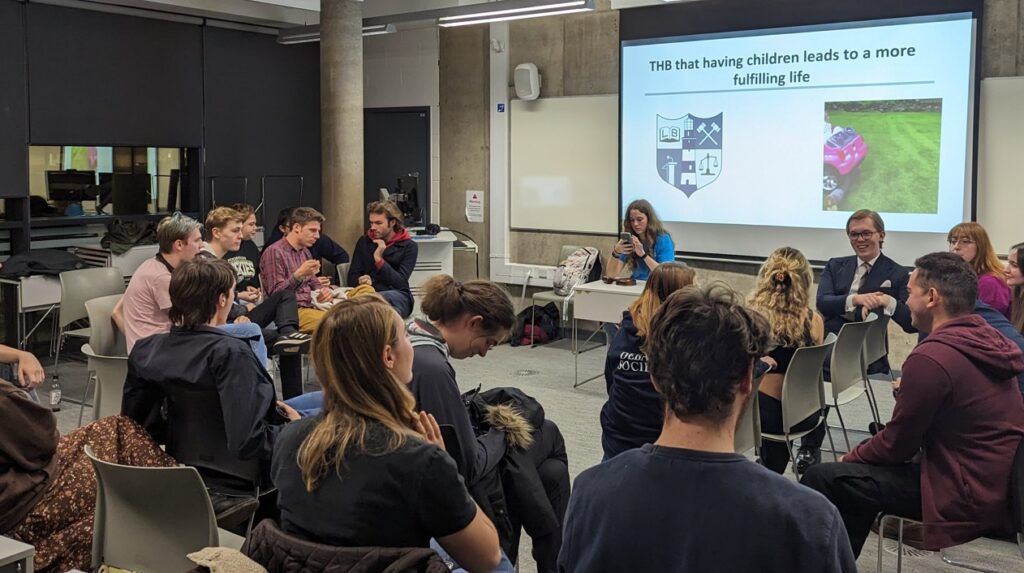
At the University of Plymouth, Debate utilizes a less formal iteration of the Westminster system. The room is divided into three sections; proposition, opposition and fence. Perhaps best described as a hybrid of the Westminster system and the vote with your feet format promoted by the United Kingdom Youth Parliament.
Members submit motions each week and then vote via poll to select four of the submitted motions to be discussed in 30-minute blocks over a two-hour meeting. Motions are usually defined as either “this house believes” (THB) or “this house would” (THW). Two motions in a given week might be ‘this house would raise the legal drinking age’ and ‘this house believes that vaping indoors is socially acceptable’ as examples.
Unlike the Westminster system recognized by the World Universities Debating Championship (WUDC), which recognises speakers in parliamentary roles of Prime Minister (PM), Leader of the Opposition (OL), deputies and whips – the University of Plymouth sessions are facilitated by a central Chairperson. Any individual from proposition (for the motion), opposition (against the motion) and fence (undecided) can raise their hand to signal intent to speak and are each given between one to two minutes each to speak.
In this format, members are encouraged to think of speaking points in the moment and to avoid rehearsing their points before the meeting. Members are also encouraged to speak from perspectives that do not necessarily align with their own beliefs or opinions on a given motion. Intentionally advocating the role of devil’s advocate with the goal of promoting confidence with public speaking by separating their instinctive emotive output from their spoken voice.
Debate Society, neurodiversity and third space
Neurodiversity has become a core aspect of the University of Plymouth Debating Society. Where higher education is a space in which neurotypical students experience the pain of psychosocial growth through a journey of self-exploration; neurodiverse students experience this same pain with the added emotional strain of masking.
That intentional effort towards softening hierarchy and widening participation enables neurodiverse students to explore their sense of self without having to supress their natural traits to avoid stigma and adhere to the social hierarchy of their immediate peers.
They can select roles to play such as speaker, researcher, strategist and organiser. In this negotiated student-led space, they can then draw on their cognitive strengths like deep-knowledge, pattern recognition and intensive focus – translating these strengths into practice.
For neurodiverse students then, Debate functions as a third space in the higher education context because it exists at the intersection of formal academic structure and the student social world. At this intersection, identities, roles and cultural norms are negotiated rather than prescribed.
Indeed, enabling neurodiverse students to cross boundaries, co-construct meaning and explore their own voice within a predictable structure with flexible participation; facilitates the establishment of identity positions that embrace their neurodiversity whilst scaffolding transferable skills.
A sense of community and a sense of “us”
How then do we evidence the success of the University of Plymouth Debate Society operating successfully as a third space that creates community – for both neurodiverse and neurotypical students? The annual debate society awards ceremony is just one way that the society comes together outside of regular debate meetings. Over the last near decade, the society has engaged in a range of socials and community focused projects that highlight the importance of spaces like this in higher education.
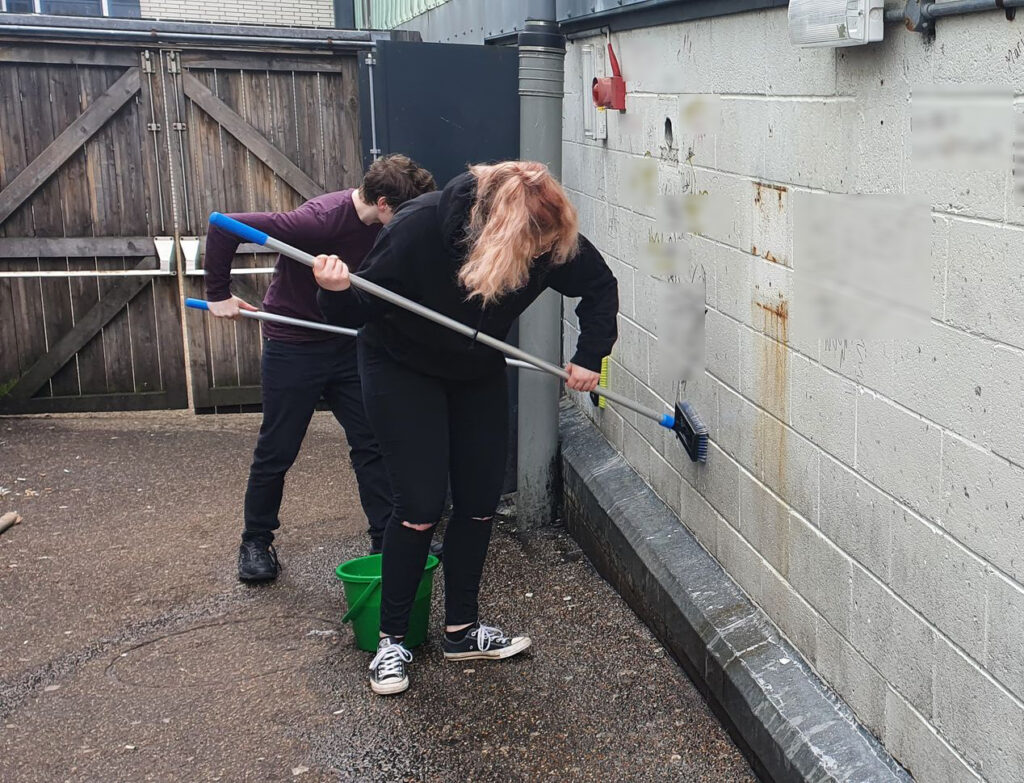
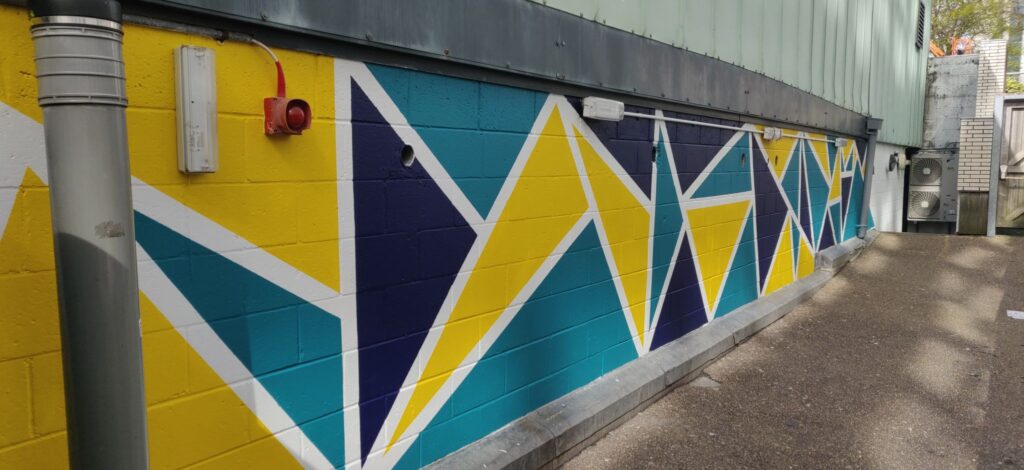
Perhaps the most visible community project was In the 2021/2022 academic year. The UoP Debate Society came together to repaint the smoking area at the University of Plymouth Students’ Union. On club nights, the plain white wall to the rear of the facility had been vandalized and a range of problematic graffiti had been introduced. Students from the society volunteered to clean off the wall and paint a mural that would discourage future incidents.
“I wanted to help highlight that students care about our campus, by giving something back to the community that has helped us to flourish during our time at University.” – Chloe, UoP Debate Society.
Five years later, the mural remains and happens to still be graffiti free.
“Volunteering to help repaint the wall allowed me to express my inner creativity and explore the application of a new skill.” – Charlie, UoP Debate member.
Shared meals and cross-community collaboration
At least once a week, members of the society share a meal together in the city centre. This ritual provides a predictable social interaction without performance pressure that usually applies to most social settings. In this context, neurodiverse students who may often feel peripheral in other campus spaces can feel like part of a community and valued for who they are without performative masking.
Whilst not celebrated in the United Kingdom, the society previously hosted a Thanksgiving dinner to help raise money for charity, whilst also providing some home comfort to an American international student unable to fly back to the US for the holiday.
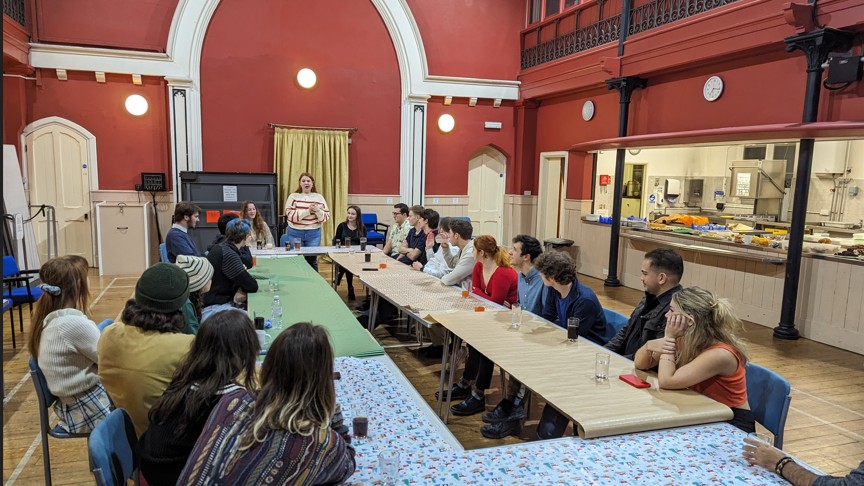
The society booked a nearby church hall and invited members of the University Rounders team to join for the shared Thanksgiving meal. Saffron, the Chair at the time said:
“We wanted to do something different to […] celebrate Thanksgiving, so everyone bought a dish, and we laid it all out and members could help themselves. We down together to share our food and what we were thankful for. It was a really nice chance to reflect on the good things we have in life, the community we have all found in Debate…“
“Since moving away for University, it’s always nice to have a piece of home with you, and being able to share that with debate meant a great deal to me, it was so much fun sharing this with everyone!” – Mori, UoP Debate Society.
Beyond this, the society has often invited other student groups to their regular meetings – with themed sessions around the topic of the invited other group. This enables the groups to share their passions with each other and compare perspectives in an open and fun environment.
In 2024, the society collaborated with the University of Plymouth Pole Dancing club to volunteer in a litter picking effort within the Drake ward of Plymouth City. With seventeen individuals volunteering over two hours, the volunteers filled up 46 bags of rubbish and collected an array of vapes to be recycled.
What the future holds…
As the 2025/2026 academic year draws to a close, the UoP Debate Society has elected a new committee to continue the journey. Students from across a range of academic disciplines and levels of study will be taking up the mantle of leadership within the community and setting their sights on the 2026/2027 academic year.
I am extremely privileged to have been able to witness successive cohorts of students explore themselves through the format of Debate and as things continue forward – building a strong community of students and alumni – I look forward to seeing where the journey takes them next.
I recently embarked on a new challenge at the University of Plymouth, supporting the institution with the rollout of a new digital examination platform. This means that after five years, I’ve concluded helping to build the Student Digital Champions at the institution, which is now part of a new learning support team.
I originally joined the Digital Champion scheme during its original pilot run, under the COVID-19 lockdown restrictions in the UK at the time. At its outset, the scheme fed the student voice into decision making processes about the usage and provision of digital tools and technologies within the institution.
From humble beginnings, the peer-support scheme grew to include the design and provision of bespoke digital skills seminars and operated a digital literacy drop-in service. Growing from a team of three student partners to a team of fourteen, the Digital Champions experienced an approximate 850% service usage growth between the academic years in 2022 and 2025.
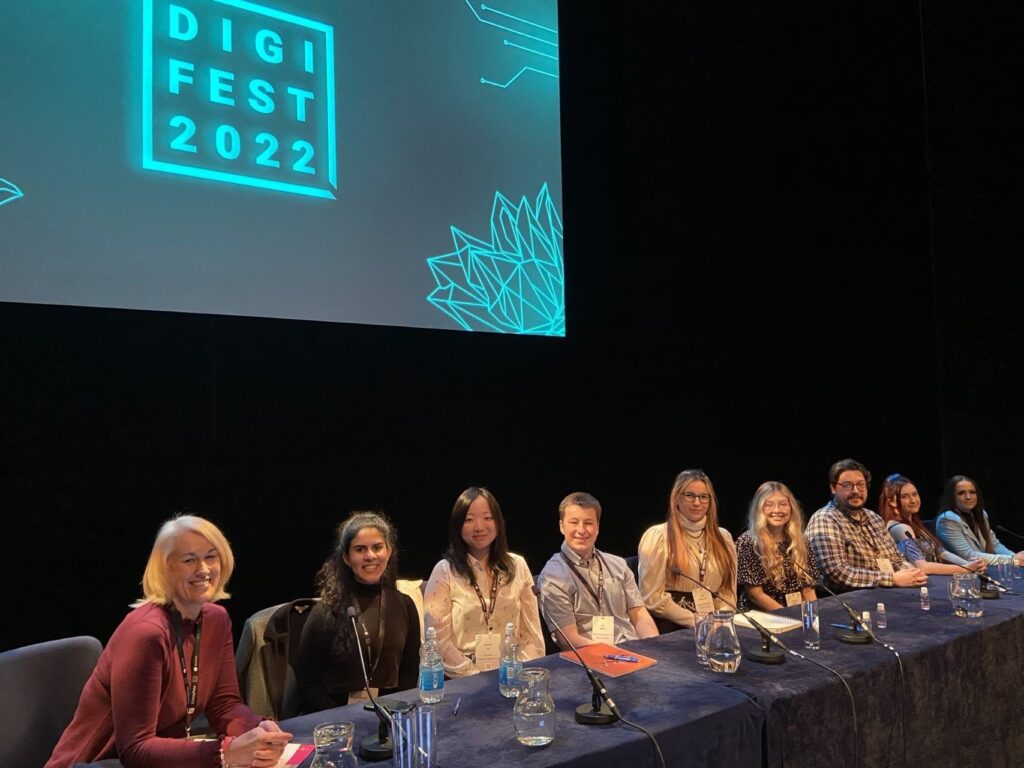
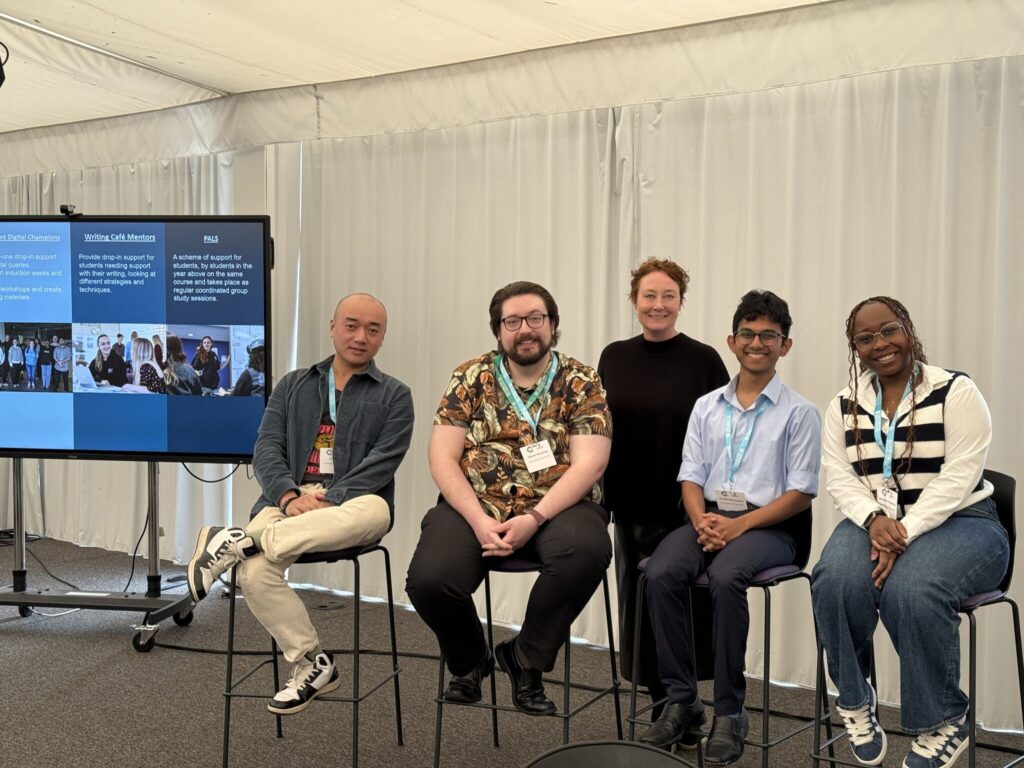
Over the years, we had a number opportunities to share what we were building with other higher education institutions in the UK. As part of a wider student panel exploring digital advocacy, we shared our experiences of online learning during the COVID restrictions at JISC Digifest, JISC Connect More and JISC Change Agents Network in 2022. We returned to JISC Change Agents in May 2023 and spoke about empowering student partners as co-creators at the Advance HE: Students as co-creators symposium in January 2024.
The rise of AI in Education
With the higher education sector increasingly relying upon digital technologies to provide learning experiences, it’s important that we recognize the value of empowering students to become digital advocates through peer-support in the environments that we are creating. Within the UK HE context, we’ve entered a new era of learning experiences where University entrants have been using Large Language Models (AI) since secondary school.
If we reflect upon massive technological impacts in education, we could perhaps view the 2000s as the era where “Google” became synonymous with using an internet search engine to answer a question. Students were turning to Google to find an answer from the growing library of information on the world wide web rather than trekking over to the physical library and asking for help.
We might later reflect upon the 2020s as the era in which the practicalities of seeking knowledge have changed once again, where “ChatGPT” replaces “Google” as the synonym for technological extensions of the human mind engaging in information retrieval. The place of AI in Education is therefore an important conversation that is happening at Universities around the world already.
Whilst the government in the UK has started to form policy on the issue: I’m wondering however, what extent is the sector taking advantage of the student voice and their student communities to understand how new University entrants and young people are integrating AI into their day-to-day learning experiences? Is the sector, are we listening enough?
Learning from the student voice
Last year, I was invited to speak to the British Association of Lecturers in English for Academic Purposes for (BALEAP 2025) about how our Digital Champions supported international students. Picking up sticks and moving to a new country is daunting, but this can be even more so challenging for international students entering the UK education system for the first time.
Not only do they have to learn new cultural and social norms, but they also must learn new digital ecosystems. To those of us that these systems are native for, our experience with them makes it easy to forget what learning to use them felt like. This means that there are gaps in our how we provision teaching and learning where knowledge of these systems is taken for granted. We assume that all of our students are on an equal footing in our digital ecosystems. That’s where peer-support schemes like the Digital Champions act as an invisible safety net. The experiences and voices of the student partners, positioned as experts through experience, enables those students to whom these systems are unfamiliar to gain insight that isn’t currently provisioned through formal timetabling.
So, what if we reverse the roles when we approach the conversation about AI in Education. Colleagues that experienced the rise of search engines replacing reference textbooks and the transition to digital assessment submissions – now resistant to the innovation of AI in Education – should perhaps be viewing new University entrants as the experts in AI.
If we’re not open to learning from them what role AI is playing in their lives, we risk being left behind whilst we’re standing at the front of the classroom.
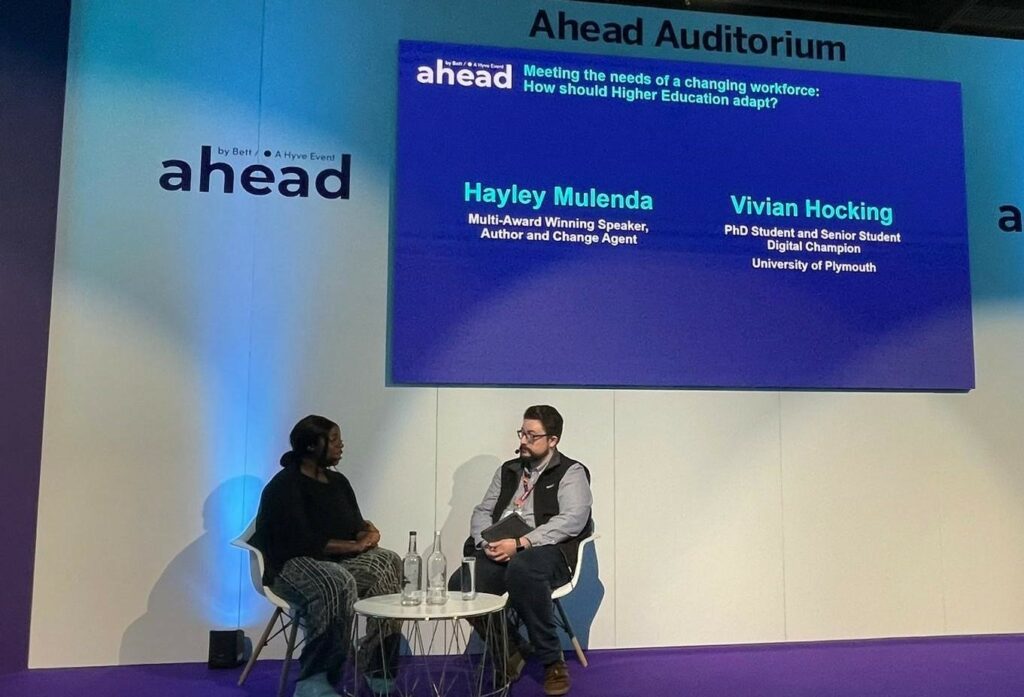
Earlier this year, I had the opportunity to interview multi-award winning international speaker Hayley Mulenda at the world’s largest education information technology showcase. Attended by more than 30,000 educators, policymakers and industry change makers – the BETT Showcase featured an array of events and talks for the education sector.
Having previously presented alongside colleagues from the University of Plymouth at the Jisc Change Agents Network in 2022 and in 2023, Jisc recommended our Student Digital Champion scheme to the event organizers in seeking a keynote speaker. I was privileged to be invited to facilitate the morning keynote at Ahead at BETT on Friday 24th January – in conversation with Hayley Mulenda.
Hayley chose to begin speaking out about her experiences after nearly taking her own life at the age of eighteen and has become a powerful advocate for diversity and inclusion across the world, helping leaders to bridge the gap between millennials and Gen Z. Hayley’s work focuses on remembering the power of authenticity and vulnerability in a world that has an overabundance of ‘role models.’
In conversation with Hayley Mulenda
In our keynote session titled “Meeting the needs of a changing workforce: How should Higher Education adapt?” Hayley and I chatted about what had motivated to begin speaking out following her experiences, strategies young people can take advantage of to avoid burnout whilst pursuing success and becoming a “real model” rather than a “role model.”
Hayley reflected upon her higher education experience under the UKs lockdown restrictions imposed in response to the COVID-19 pandemic and how her institution had taken the wrong approach in responding to student wellbeing. Building on Hayley’s experiences and the prevalence of social media in the lives of Gen Z, I asked Hayley how she thought higher education institutions might be able to take advantage of social media to empower students in regards to their wellbeing as they start to think about entering the graduate job market for the first time.
Drawing on Hayley’s wealth of experience in the corporate sector, acting as a board member for restaurant giant Wagamama, Hayley and I also chatted about how organizations might be able to better prepare to welcome Gen Z into their workforce, whilst emphasizing the importance of personal empowerment and individual wellbeing.
Reflecting upon our conversation at BETT, Hayley said:
“Bett Show 2024! We spoke about mental health, graduate recruitment, student experience, Gen-Z and so much more! It was a great discussion with Vivian Hocking on what Higher Education can do to meet the needs of students and young people today!”
In September 2021, graduates were once again able to celebrate their hard-fought achievement of earning their undergraduate degree certificate with in person graduation ceremonies on the Plymouth Hoe. Following that in December 2021, postgraduate students from Plymouth were also celebrating their successes with in-person ceremonies at the Plymouth Guild Hall.
These events marked the first return to in person ceremonies since Plymouth Gazette reported on the decision to hold digital celebrations in lieu of traditional ceremonies, which was part of response measures to the Coronavirus pandemic. Both forms of graduation are typically however followed by celebratory social media posts.
It’s not unusual to see photos of graduates with their course-mates and their families popping up on social media followed by numerous congratulatory responses. Indeed – why shouldn’t you post photos of your achievement?
Well, if your post includes a copy of your digital award (usually supplied in PDF format) or a selfie with your newest qualification, you might want to think twice about exactly what you do share to social media.
A quick scroll through social media feeds back in September of 2021 showcased the degree certificates of other graduates from across various different cohorts at Plymouth as well as graduates from other Universities. A similar look around social media now and you can easily find postgraduate transcripts with a variety of sensitive personal data on them.
What the experts are saying about posting your degree certificate online
JISC, which provides the University of Plymouth with a lot of the backbone for its digital infrastructure, warned back in August of 2020, that sharing images of your important documents online can give fraudsters access to information that enables them to make fake documents.
Prospects, which is run by JISC, further explained that sharing your degree certificate online gives fraudsters “access to logos, crests, signatories, stamps, holograms and wording,” further highlighting that these tend to be unique to each higher education institution and are often changed each year to help combat degree fraud.
The Guardian reported on these same sentiments back in June 2018 where they quoted Jayne Rowley, now executive director of student services at JISC, as suggesting that posting your degree certificate online is comparable to sharing a photo of your passport or driving license on the internet.
Aside from your University potentially suffering from degree fraud because of degree certificates or transcripts appearing on social media, the reason you should be concerned is the threat of social engineering.
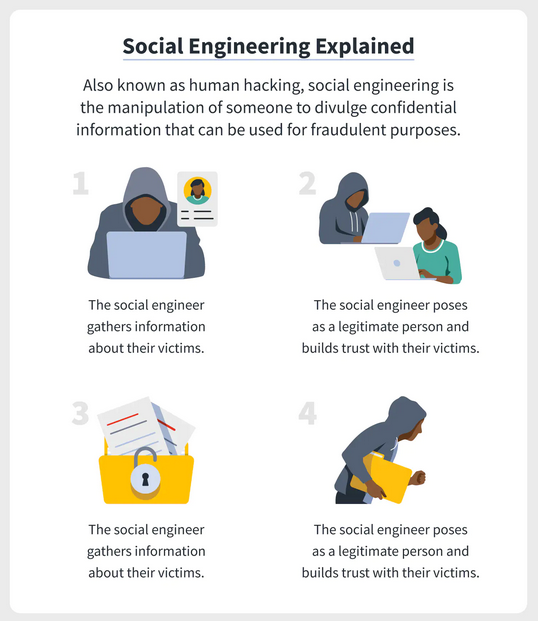
Social engineering is a broad term that covers a range of manipulation techniques employed by cyber criminals to illicitly gain access to or control over your data. For a keen fraudster looking to gather information about someone or an organization to target, social media provides a fertile ground of intel that can be used as a starting point for a wider campaign of attack.
NortonLifeLock (formerly Symantec Corporation), outline that at the core of social engineering is typically a four step process of building false trust with a victim and then using persuasion to gain further information about you and their target.
Being manipulated
As an example, your university statement of results includes your student ID number, your name and your date of birth. If you post this publicly online, you’re giving public access to your date of birth and student id number, which are key components in how whichever university you are enrolled at knows who you are.
In a scenario where an attacker wants to gather further information about you, they might have already found your transcript on your LinkedIn profile and call you whilst you’re at work. The attacker poses as an administrator at your university wanting to make sure your records are up to date – they tell you what your name is and read you your student id number and then ask you to confirm your date of birth – in an act of building false trust.
The attacker then asks you to provide your address and current telephone number to ensure the university records are up to date – which you provide. The caller thanks you for your assistance, wishes you a good day and the call ends. The conversation goes to the back of your mind along with any other day to day calls that you don’t need to remember.
Cyber-attack
You might be asking yourself why an attacker would want to pretend to be you after you’ve already graduated – but universities do typically keep graduates accounts active for a set period of time after they’ve left the institution. This provides an avenue through which attackers could exploit the information they’ve found on social media and after obtaining further information from their target, to gain control of your university account.
Now that the fraudster has access to the information from your transcript as well as your address and contact number, they can now contact the University and pretend to be you.
Why is this important? Over the last few years, cyber-attacks against universities have been increasing as research data and personal data held by these institutions continually grows in size and value over time. Having access to your account, might help a social engineer to deploy malware or ransomware.
In 2019, the University of Maastricht was taken completely offline after attackers managed to deploy ransomware within their systems. Likewise, Brown University had to take systems offline in April this year following a cyber-attack and the University of Sunderland announced system outages in October this year following an attack.
Why should I care?
Depending on the experience you had whilst at university, you might not particularly care if your institution is attacked after your graduation – but the scenario above can also be applied in reverse. If you become the target rather than your institution, lets assume because an attacker is interested in targeting your graduate employer, the information you’ve shared on social media could be used to find out more about you by impersonating you when contacting your university.
In summary, graduating is for most students a once in a lifetime experience and it’s only natural to want to shout from the rooftops after all the work you’ve put in has finally paid off.
Just don’t celebrate by posting your degree certificate, one of your most important legal documents, on the internet.